 (701) 588-4541 |
 |
|We Rise by Lifting Others
It is sometime between the years 30 and 33 A.D. In the Roman province of Judaea, Pontius Pilate serves as fifth Praefectus (Prefect, Governor) of Judaea, at the pleasure of the Emperor Tiberius Caesar in Rome, from 26 to 36 A.D.
In the ancient Land of Israel, the Sanhedrin (‘assembly,’ ‘council’) is the Jewish legislative and judicial assembly of 70 elders that presides at the highest level of Jewish political and religious authority in the long chain of Biblical tradition from the time of Moses.
It is the time of Jesus. The leadership of the Sanhedrin hates Jesus and conspires to kill Him.
Two Jewish men, Joseph of Arimathea and Nicodemus, are members of the Sanhedrin.
Joseph of Arimathea is described as an “honorable counselor, who waits (‘is searching’) for the kingdom of God” (Mark 15:43). Joseph is described as “a good man, and just” (Luke 23:50).
Nicodemus is a Pharisee, a Teacher of The Law of Moses, and also a member of the Sanhedrin. Nicodemus is a “rich man” and a secret disciple of Jesus (Matthew 27:57; Luke 23:50).
Nicodemus has gone secretly, in the dark of night, to visit with Jesus, and listen to His teachings (John 3:1–21). Nicodemus fears the wrath of his colleagues in the Sanhedrin, if they should find out about his meetings with Jesus.
Joseph and Nicodemus risk their lives, their fortune, and their sacred honor to cross the line of perceived loyalties, fearing the wrath of their colleagues in the Sanhedrin.
According to the Gospel of Mark, on the day of His Crucifixion, Jesus dies at the 9th hour (about 3 pm).
Following the death of Jesus, Joseph of Arimathea “(asks) Pilate that he might take away the body of Jesus, and Pilate (gives) him permission” (John 19:38).
Joseph purchases a linen shroud (Mark 15:46) and Nicodemus purchases myrrh and aloes (John 19:39). Joseph and Nicodemus then go to Golgotha, also known as Calvariæ, the place outside Jerusalem where Jesus is crucified.
Golgotha is an Aramaic word, meaning “skull.” The four Gospel writers use the Greek word, Kraníon, meaning Cranium, the part of the skull enclosing the brain. The Greek word, Kraníon is translated as Golgotha in Aramaic, Calvariæ in Latin, and Calvary in English.
There, at Golgotha, Joseph of Arimathea and Nicodemus take the body of Jesus down from the cross.
They wrap the body in clean linen, with the spices purchased by Nicodemus.
They carry the body of Jesus to a cave tomb in the garden of Joseph’s nearby house, and place it in a “new” tomb, Joseph’s own, unused, tomb (Matthew 27:60).
The hurried burial preparation of Jesus is only partially completed, “for the Sabbath (is) drawing on.” (Matthew 27:55–61, Matthew 28:1–10, Mark 15:40–16:11, Luke 23:50–24:10, John 19:38–20:18).
When Joseph of Arimathea personally requests and receives permission from Pontius Pilate, the Roman governor, to remove and care for the body of Jesus, Joseph crosses the line.
When Nicodemus, without hesitation, joins with Joseph to care for the body of Jesus, Nicodemus also crosses the line.
The Sanhedrin, the Council of 70, regard Joseph and Nicodemus as traitors. Caring for Jesus is viewed as an affront to the authority and dignity of the Sanhedrin.
For Joseph and Nicodemus to openly care for Jesus, and thereby ally themselves with the followers of Jesus, is treachery.
Joseph and Nicodemus are members of the Sanhedrin, the Jewish leaders who orchestrated the Crucifixion of Jesus, but they choose the opposite path.
Joseph of Arimathea and Nicodemus openly cross the line.
In the time of Jesus, the Sanhedrin meets in the Jewish Temple in Jerusalem, in a building called the Hall of Hewn Stones. The Sanhedrin convenes every day, except for festival days, and Shabbat, the Sabbath day.
At this time of year, at Passover, can you visualize what it must have been like for Joseph and Nicodemus to return to their seats in the great Hall of Hewn Stones, in the center of their greatest danger, in the midst of their wrathful colleagues, in the Sanhedrin, on the next working day after the Crucifixion of Jesus?
Can you imagine what it may have been like?
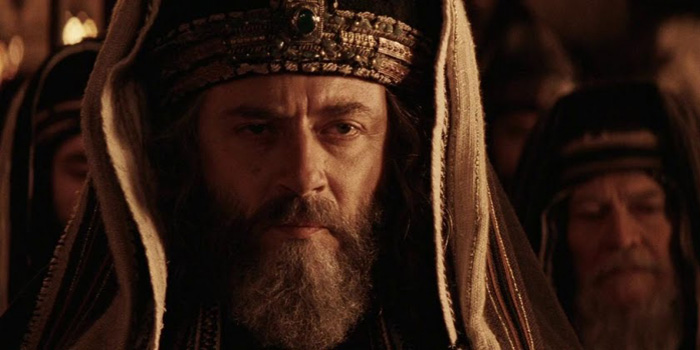 |  |
Members of the Sanhedrin are gathering in groups. The white marble Hall of Hewn Stones is noisy with animated discussions of the recent troubles about that imposter, Jesus.
“His followers are claiming He is risen from the dead? Really? What rubbish! Did you hear about Joseph and Nicodemus? What traitors they are! They desperately need to be punished! How shall we do it?”
As Joseph and Nicodemus quietly enter the great marble hall, the noisy chattering gradually begins to subside. Soon the great hall is quiet. Dead quiet.
In the place where eyes meet eyes, toxic looks surround the two friends of Jesus.
Unfortunately, the Gospels do not record anything more about Joseph of Arimathea and Nicodemus after the burial of Jesus on Good Friday. The Gospel record is silent.
Jesus said, “Take up your cross, and follow Me” (Matthew 16:24; Mark 8:34; Luke 9:23).
To people of the first century, the cross meant death by the slowest, most excruciating, painfully exhausting agony and suffering imaginable, on the very last day of a person’s life.
The Romans forced convicted criminals to carry their own heavy crosses to their own place of crucifixion.
Taking up your cross meant carrying your own means of brutal, dishonorable, torture and death with you, surrounded by pushing, shoving, shouting crowds of contemptuous, mocking, jeering tormentors.
All alone, within the smothering noise of laughing, taunting, sneering shouts, wracked by intense physical and mental pain, you stumble forward on your own hopeless path of death toward the last few moments of your life on earth.
What we know, for sure, is that crossing the line has never been easy.
It is making the honorable choice, when no one is watching, when everyone is watching, when no one cares, when everyone cares.
It is making the honorable choice, because Jesus cares.
Amazingly, for more than 2,000 years, millions of His followers willingly, without hesitation, make the choice . . . to cross the line.