(701) 588-4541 |
 |
|The Gulf of Tonkin (Vịnh Bắc Bộ, northern bay) is in the northwestern part of the South China Sea, off the coast of North Vietnam (Tonkin, Đông Kinh, eastern capital) and Hainan Island, People’s Republic of China.
Wednesday, February 5, 1969

It is Zero Dark 30 on Yankee Station, about 90 miles off the coast of North Vietnam. I am a young naval officer standing the bridge watch on board a U.S. Navy destroyer underway in the Gulf of Tonkin.
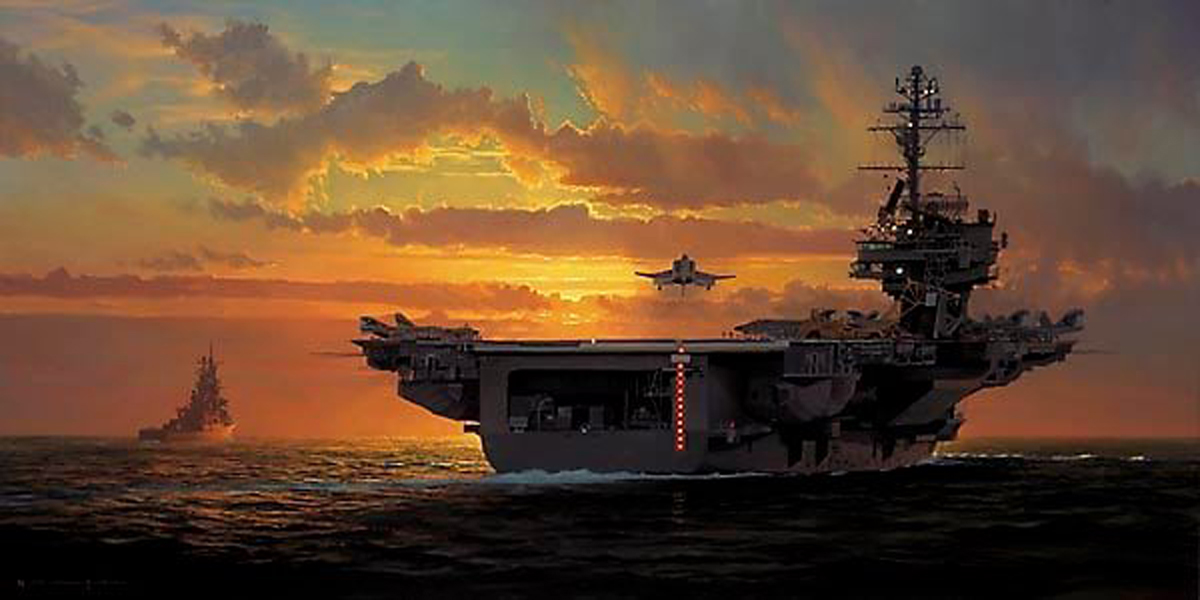
My ship is USS FLETCHER (DD-445), homeported in Pearl Harbor, Hawaii, call sign “Radish.” Fletcher is part of the carrier strike group of USS HANCOCK (CVA-19), call sign “Rampage,” homeported in Alameda, California.
“Hanna” is an Essex class aircraft carrier. She is the fourth ship of the U.S. Navy to be named in honor of John Hancock, president of the Second Continental Congress.
On July 4, 1776, John Hancock presided over the signing of the Declaration of Independence. He was also the first governor of the Commonwealth of Massachusetts.
U.S. Navy Douglas A-4F Skyhawks of Attack Squadron 55 (VA-55) “War Horses” and Attack Squadron 164 (VA-164) “Ghost Riders,” are the ship’s firepower, enough firepower to rival the air forces of many nations.
These two squadrons are assigned to Attack Carrier Wing 21 (CVW-21), aboard “Hanna.”
Fletcher’s job, and that of our sister destroyers in the carrier strike group, here in the Gulf of Tonkin, is to protect “Hanna” from harm.
Fletcher is in plane guard station, about 2,500 yards astern of “Hanna.”
Our purpose is to serve as a visual reference for the carrier’s Landing Signal Officer (LSO), and to function as plane guard to rescue any ship’s personnel who might fall overboard during flight ops.
Aircraft carrier flight operations are inherently dangerous. We are ever watchful and ready to recover any aircrew whose aircraft may crash or have to ditch in the ocean during carrier flight operations.
The plane guard role is also dangerous. Aircraft carriers often change course and speed to maintain best wind conditions for aircraft take off and landing.
Any lack of awareness or inattention by either ship, especially at night, in extreme weather, or with battle damage, can put the plane guard ship under the bows of a rapidly maneuvering carrier traveling at full speed.
When Fletcher is not in plane guard station, we are miles ahead, or on either side of “Hanna,” fanned out with other destroyers of the carrier strike group.
We are “tin can” destroyer sailors who provide early warning screening, defense in depth, and search and rescue support to protect “Hanna” and her crew from harm.
It is 0203, early morning. Today, Fletcher is in plane guard station, 2,500 yards behind “Hanna.” It is pitch black, except for pinpoints of ship navigation lights.
I am standing the bridge watch on Fletcher when a Vought F-8H Crusader aircraft lands heavily on “Hanna’s” carrier deck and explodes in a huge orange fireball right in front of me.
At first light, we find pieces of fuel cells from the wing tanks, and a piece of a flight helmet, in the thinly scattered debris floating on the surface of the Gulf of Tonkin.
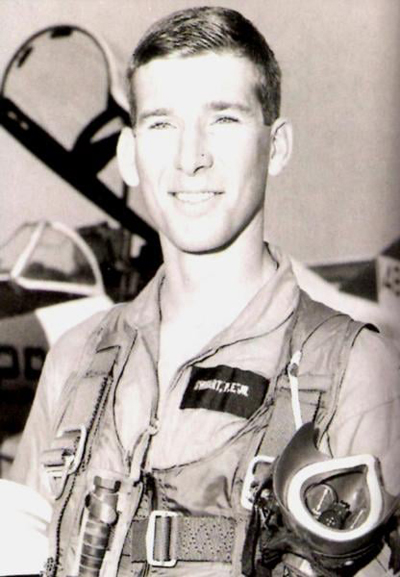
Lieutenant (junior grade) Paul Eugene Swigart, Jr., USNR, a pilot in Fighter Squadron 24 (VF-24) “Fighting Renegades,” Carrier Air Wing 21 (CVW-21), aboard USS HANCOCK (CVA-19), is killed. His body is not recovered. He is 25 years old.
LTJG Swigart is from Seal Beach, California. His MOS (Military Occupational Specialty) is Unrestricted Line Officer, Pilot (1315).
Earlier today, he flew from a base in South Vietnam to land on the flight deck of USS HANCOCK (CVA-19) on Yankee Station in the Gulf of Tonkin about 80 miles east of North Vietnam.
At Fort Rosecrans National Cemetery, San Diego, California, he is named on a memorial headstone in plot MA 0 105. His name is inscribed in the Courts of the Missing, Court B, National Memorial Cemetery of the Pacific, Honolulu, Hawaii.
His name, PAUL E SWIGART JR, is inscribed on the black granite Vietnam Veterans Memorial (Panel 33W, Line 69). His name is one of 58,307 names on “The Wall” in Washington, D.C.
Sunday, February 9, 1969
It is now four days later, 0604 in the morning. We are 125 miles east of North Vietnam. Fletcher is in screen station, five miles off the starboard beam of USS HANCOCK (CVA-19).
A Douglas A-4F Skyhawk from Hancock catches fire during the catapult shot, and crashes into the Gulf of Tonkin. As “Hanna” passes by, the pilot is seen inside his plane, sinking on the starboard side.
Fletcher assists in search and rescue operations in the wreckage area. We find two signal wands, part of the cockpit seat, and some insulation.
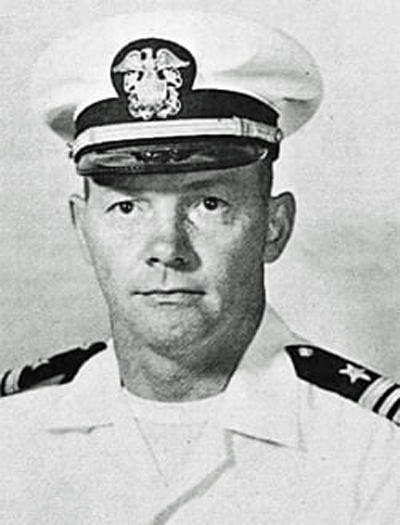
Lieutenant Commander Roger Allen Meyers, USN, a pilot in Attack Squadron 164 (VA-164) “Ghost Riders,” Carrier Air Wing 21 (CVW-21), aboard USS HANCOCK (CVA-19) is killed. His body is not recovered. He is 35 years old.
Lieutenant Commander Meyers is from Chicago, Illinois. His MOS (Military Occupational Specialty) is Unrestricted Line Officer, Pilot (1310).
At Arlington National Cemetery, Arlington, Virginia, he is named on a memorial headstone in Memorial Section 3. His name is inscribed in the Courts of the Missing, Court B, National Memorial Cemetery of the Pacific, Honolulu, Hawaii.
His name, ROGER A MEYERS, is inscribed on the black granite Vietnam Veterans Memorial (Panel 33W, Line 94). His name is one of 58,307 names on “The Wall” in Washington, D.C.
No one wants to be a Gold Star Family.
Gold Star Families remember their family members who have died in military service.
As a nation, we honor the ultimate sacrifice of Gold Star Families.
As human beings, we acknowledge the loss, the grief, the need for continual healing of Gold Star Families.
Men and women who die in military service give their last full measure of devotion to the people of the United States. They give the ultimate sacrifice of their lives for the rest of us.
The least we can do is remember them.
This day, I remember U.S. Navy Lieutenant (junior grade) Paul Eugene Swigart, Jr., USNR.
This day, I remember Lieutenant Commander Roger Allen Meyers, USN.
I was there. I remember.